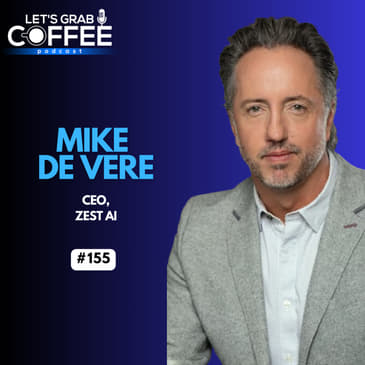
As an executive at Zest AI, Mike has made it the company’s mission to leverage AI in consumer credit underwriting to build financial equity and create a better, richer, and fuller life for all. In his 25 years prior experience to Zest AI, Mike focused on amplifying the voice of consumers to governments and businesses through organizations like Nielson, Harris Interactive, and JD Power. His experiences converge to show his capacity to lead organizations in translating data into insights that enable the betterment of consumers’ lives.
[00:00:03] This is the Let's Grab Coffee Podcast and I'm your host George Khalife. Mike you got to do this again. Oh no absolutely it's the Mike and George coffee. Let's grab some coffee. Love it love it. Well Mike thanks for being here.
[00:00:18] I appreciate you being on the podcast and as I said big fan of view as an entrepreneur as an exec in the startup kind of fintech world and excited for the for the conversation so thanks for making the time. Sure thank you so much.
[00:00:33] You've been in the tech entrepreneurial world for quite some time if I can say you know 20 25 plus years and what I love about your story is it's really focused actually around consumers to governments that connectivity and specifically around customer insight.
[00:00:51] I always wonder how did you get your start into this whole world that you've been pretty consistent with for the past 20 years? I had a great professor at Cal State Northridge who taught statistics and he taught everything in the context of gambling.
[00:01:07] Now I'm not telling you right now George I'm some massive gambler or gambling problem per se it's that it's that he made it such an ending topic and so approachable and so I've always loved math you know I'm one of those people that if you ask the
[00:01:20] question do you love calculus I'll resummonly say yes I love calculus but you know I look back across my career it's always been taking data applying some math to it and trying to drive some insight and so whether you're talking about being at
[00:01:35] you know JD power you know in some of the early years at JD power or getting to be at Nielsen and TV ratings or the Harris Bowl or even here at Zest everything is about taking data and transforming it taught some meaningful insight.
[00:01:49] Have you seen a obviously you know we're gonna get into the AI craze in a second here but for someone who's been in the data world for that long what did it look like 15 you know 20 years ago versus how it looks like today for those
[00:02:05] who aren't in that space as closely as you are. Oh my word I remember so I remember so when I was at JD power we would have clients and you do this research study and you would print out all of the tables with
[00:02:24] any people basically a pivot table any potential outcome or cross tab that you could come off with and you'd have you know binders that are 10 inches stacked up on your desk and you'd be going page by page trying to create a story which now
[00:02:38] today actually AI can do for you and bind those insights for you but my gosh I think that's what I've loved throughout my career is that you know I tend to look at multiple different factors I'm able to pull it together and a
[00:02:54] simpler story and that also applies to going after a strategy or how you run your business and things like that you're constantly being fed data but somewhere in there is that thread is that strategy and you have to be able
[00:03:06] to basically distill it down to some action and so yeah so I do remember the binders that you know we deliver to American Honda that these were probably as tall as me stacked up every month with insights and you know it's a different time for sure.
[00:03:25] Yeah that's fascinating I was actually having a conversation with a colleague internally about data and then how important it is for it to be clean but also how important it is for literally every function you can imagine I'm
[00:03:37] more in the sort of business development slash sales world in my work and then you know how important it is with Salesforce as an example or just to stay on top of you know your ecosystem and to understand
[00:03:51] your activity to the dot how important that is is super critical but you also don't get the same level of attraction I would say to data in an organization like some people love it some people are a bit resistant to it.
[00:04:06] Do you feel that especially being involved so closely to big data that there are different levels of attraction I would say to it? Well I don't know about attraction I mean Valentine's Day is a pass so
[00:04:19] I don't know much about that but what I can tell you is that to be able to do any of the jobs that I've done or even you know currently at SDI data is king and making sure that it's appropriately representative
[00:04:31] and probably George I've been surrounded by a bunch of math geeks my whole career and so we all love data and so yeah there's probably a great affection for it and if I were to replace my wife
[00:04:41] Nancy on Valentine's Day probably be in the category of data really a rich data set. In the data space what's the hardest part for you like is it that sort of extraction is it the cleanup of it is it making sure
[00:04:54] that the organization is fully aligned as to how to map it like what part of the process is the most difficult. Well I think you know when you're dealing with lots of data you've got a lot of challenges so there's the missing data question
[00:05:07] and so if you're dealing with something having to do with consumers and like a credit profile and you have missing data current credit system says I can't actually even score them so they kick them out of the ecosystem.
[00:05:20] So it actually has real world impacts if you have missing data and how to solve for that. The second area really comes around representation making sure that you have representative data for the problem you're trying to solve in my days at the Harris poll and
[00:05:34] if I'm doing a political poll I need to make sure that I have a sufficient cell of Asian American Pacific Islanders if I'm going to be doing the survey or a poll in the Hawaiian Islands but yet often times here in the US we are OK with doing
[00:05:50] surveys or research or trying to glean insights with these large national data sets that under represent communities and they actually leave them out. The decision or outcome that you're trying to drive towards is that what's been your sort of personal driver and I know
[00:06:07] we'll get to zest in a sec but I feel like you have this personal inclination to make sure that there's some I would say fairness right some transparency behind the data and making sure it's fairly equal to everybody who it's leveraging for it is personal.
[00:06:23] I mean I think about my dad grew up in the San Fernando Valley. He's the son of a Navy man and great Irishman my grandfather grew up in the converted and go but finished his career you know after the Marine Corps you know running a multi-dillion
[00:06:39] dollar defense company and so why that matters is that my dad had lived the American dream and I'm able to stand on that giant my father and my mom and actually propelled myself ahead and so I had a lot of opportunity. I've been very privileged on that.
[00:06:55] So I think about the America that I want for my kids that few of them that I have the five of them that I have is I want something where there's an environment where everybody has an equal access to opportunity. So I don't know if it's fair fairness.
[00:07:09] It's just really this shift in that why can't we have a collective abundance where there doesn't have to be winners and losers so that we can come together and solve these problems and create an opportunity. That doesn't mean everybody's going to win.
[00:07:23] I'm not talking about you know like everybody is exactly the same there will be people who will excel at all but let's at least have everybody be starting from the same point in the race and that's that that's the
[00:07:35] drive at least for me today and as I look across my career is that's been something that's been super important to me. What has been the most speaking of what's important to you what has been because you've had several executive
[00:07:47] rules those aren't easy to go into they're not easy to stay consistent with and kind of progress over the course of more than a year usually. So I'm always actually very I'm always interested in like how do you first of all squeeze into those
[00:07:59] kind of roles build that career track for you in the world of whether it's data fintech because you have to have the technical substance plus the leadership to be able to be in a management world. So as with the father who was you know successful and
[00:08:13] capitalizing on the American dream how were you able to pivot and squeeze and navigate through your career like what do you what sort of attributes have helped you the most. So I probably start with it's something my mom my mom's an artist she's super highly she's very
[00:08:29] creative and even though you know I love math I really like creativity and so whether it be painting or art or things like that it's some of my favorite times in my life have been sitting with my mom and doing a watercolor or things of that sort.
[00:08:43] And so it's these two sides of logic where you have a highly technical like the quantitative side of it but then the soft side which tends to be more creative and so I have really focused for my life on this toughness or being
[00:08:59] relentless when I face with the problem don't go the opposite way I lean into it. You know my sport that I do you know I've tended to do martial arts for a piece better part of two decades and if you were to talk to one of my
[00:09:11] instructors they'll say I usually lead with my face I jump in face first on things get hit usually the first time. But why that matters is like this toughness is I'm willing to take a chance on myself. I'm willing to put myself in a risky
[00:09:24] situation where I might know a lot about it. I'm willing to approach problems differently and that relies on some of my creativity right. I'm betting on myself and I'm betting on the people around you. And then I would say where you know in some of
[00:09:37] my recent discussions I've been having with some of my coaches is currently in my career I'm trying to be and I think I'm getting real superpower off of just being Mike. I used to think I needed to be like every Google executive and sound like a PhD
[00:09:53] professor talking about stats all the time. But what I realized is my superpower is that you know I can tell you about you know one of our you know finance people that just had his new son and I could tell you about you know
[00:10:06] just this community that we've created at Zest people really coming together being their true selves and that I think comes with maybe time or at least a perspective that each of us can be our authentic self and if we truly are that diversity of thought
[00:10:22] and experience and everybody bringing it to the table is really where our company today is getting its power. Mike I think my love for you is expanding through this through this conversation. Only our tool hug is in a virtual hug right now. I think so.
[00:10:37] I think we can yeah we're grabbing coffee and all that. What and also you're since the reason I say that is cheers. You don't often hear that. I mean I think it's starting to be a bit of a better conversation. This whole thing around authenticity self
[00:10:52] awareness like kind of the brain a brown mindset. But it's easy to talk about it as a CEO to be honest in a very technical world where to your point you know the big players around you are very very very smart. They're very knowledgeable and sometimes
[00:11:08] that could be intimidating when you step into that role and you're like do I do I have to be such a Nadella. Do I have to be this CEO. How am I projecting. It's it's easier said than done is what I'm
[00:11:18] saying and one kudos to you for invoking that the ability just to be yourself because I think that also trickles to the entire company. If I see that in my CEO I'm like oh damn I guess I can be relaxed and just be myself.
[00:11:31] Well think of it Joy like this quiet confidence that you can have. So Tuesday I had the opportunity to go and be part of a lecture at Harvard in the business school they wrote a Harvard case study on Zest AI. I was joined by Dr.
[00:11:45] Sean Kamkar who's our principal data scientist. The guy's got a PhD from an AI from Stanford. He was at Bassett he was like a rocket scientist. I mean I don't think there's a smarter quantitative human on the planet but he does stand up comedy.
[00:12:00] He's the father of two. You see his face slide up when he talks about Margo and Jack is too like he brings in the power that he now has in the environment and culture that he and I and the rest of the leadership team have created.
[00:12:13] He brings all that to the table and is now like superpower. Yeah he's smart. He's always been smart. But now even in that class setting people were able to relate with him and connect with him in a truly authentic way. Two things how are you carving out
[00:12:26] the time as a CEO with many many different hats that you have to focus on. How are you carving out time to know all these things about your employees. I know it sounds like this is the standard and I think it should
[00:12:36] be but again I think very few CEOs might know their closest counterparts to that level of detail. Personally speaking. That's my job. I mean my job is my job is not to be the smartest guy every time in the room.
[00:12:50] My job is to bring the best out of everyone and to get our collective company leaning all in the same together but effectively as a group as a team as a community I use that word purposely community to try to solve issues.
[00:13:05] I mean that's you know if Zest AI were a human our super talent is the ability to face adversity or challenge. And we also lean into that and we evolve and we adapt to it. But that only comes from checking your ego having an organization
[00:13:21] where you're just relentless about focusing on the importance of culture and who you hire. You hire people who are OK. They don't have to be the smartest people in the room and so Sean Dr. Kamkar will never tell you he's got his PhD. He's the most humble person
[00:13:35] ever but that's different than other companies that ever did in the past where like you've got to be the smartest guy in the room. You've always got a flex in front of the boss. It's like no we don't actually celebrate that our company.
[00:13:45] Was that always the case like from day one that was a tenant of Zest AI? Was it was it as a result of something that happened that you're like you know what we got to change that. I think for me that what I
[00:13:56] brought to the table when I joined Zest over five years ago is that's what I brought and I've been blessed by surrounding myself with the new leadership team that has really led a cultural change in the organization that one that celebrates on the accomplishments
[00:14:12] of the collective not just the individual. I'm not saying that there's not smart people but I am saying what we really celebrate is the collective. It's you know like great. We grew our customer base by over 75% last year in the difficult financial markets. Pretty cool.
[00:14:27] But actually when I want to celebrate is the how we did it and the fact that people actually look forward to coming in solving the interesting problems and actually trying to move these important issues in society ahead. That's what I want to actually sell it.
[00:14:40] And so I think if I think early in my career you know you sit there and see an executive up there talking about the increase in revenue and improvement profitability driving your ebidomarge. Got it. We all learn that in business school but that's not where you
[00:14:54] work at a company. You work at a company because you believe that you can make a difference on an important difference on an important issue and it matters to me most because I care about the person who's sitting next to me. So I talked about my dad
[00:15:10] being a moraine. For him it wasn't even about any of the missions that he was ever on it was always about the brother sitting next to him. And so I think it's some of that mentality or even how he raised us being I was one of
[00:15:24] four kids as we were fighting you. He would call us a fighting like a Marine Marine together as a collective each of us had a job and we knew what each the other person was doing brought a little favorite flavor of that to zest. Love it.
[00:15:37] I don't mind intended obviously. Yeah little little favorite to zest. How did you how did you come across the opportunity like how did that happen? Walk me through the precursor. So day one how do you jump into the C O O level before becoming CEO. Yeah.
[00:15:51] So my one of my intern had just come over from Israel to be an intern for me at JD Power and Associates. Yeriv Robinson he now has an investment company called King Chisholm Investment and they had invested in zest. And so he knew that they were
[00:16:09] going to be pivoting from being a B to C lender that leveraged machine learning and AI and wanted to bring in somebody with a bit more B to B background. And so that's how I got the shake so in the end you know
[00:16:21] it was 20 years in the making by now my best friend. Wow. That's that's amazing. And how big or how small was the company then when you first first joined? He's we had a few customers something like that five years ago. So we've got other than as
[00:16:36] of yesterday maybe 185 186 customers. Wow. It's a heck of a journey. I mean like we fell in love George in the beginning with this idea like all the big banks are going to use our technology. And at the time really that's because of the cost associated
[00:16:52] the time the investment that the subject matter expertise is really was the big banks were the ones that consume it and it was great for us because it battle tested us we had to solve all these really difficult problem. But but but really the inertia came from realizing
[00:17:07] that she's mid-sized credit unions or even a small credit union like Malachi Credit Union that does hundreds of applications a year not thousands can actually have access to the same technology to the likes of like Citibank one of our bigger customers. Interesting. So you get sort of exposed
[00:17:25] to this opportunity right and they're like listen we're trying to build AI that specializes in enhancing credit underwriting the whole process through the use through the execution what do you know about credit underwriting at this point? Like in day one or was it all zero?
[00:17:42] What was the most interesting to you when you actually you know you're sitting there you're 30 days in 60 days in you're looking at the traditional credit underwriting process and what Zest is trying to do. What stands out to you the most that actually makes you excited about leading the
[00:17:56] helm of this startup? Well I mean so let me unpack that question so first you're starting in an organization you're jumping in and it's like has to do with credit. So I had been at Nielsen the TV ratings company leading the insights business which is
[00:18:12] their custom research business from Sydney Australia to poll and then now I'm going to go into credit underwriting. In the end it's just math really is just math right. And so so the topic is the same we're just applying it to a different business issue.
[00:18:27] I think for me what I'm most excited about is that we solve an important issue for our society today. And so the current credit system leaves tens of millions of Americans out. They're either difficult to score or unscorable. And it's because we're using
[00:18:43] math that was created in the 1950s which has served us well over the many years and we're many times using an industry score that was created in the 80s or late 80s or what have you which I love the 80s great music and really funny dress but
[00:18:57] there's really a better way. And so I have personally enjoyed learning from the rest of the organization that people around me because a lot of the math that we're using today was created after I was even out of school. And so it's been a cool journey
[00:19:12] for me on that front but also I think to underpin why I'm excited about it is resolving an important issue for society and for America. Where were some. America that's right. We're going to have to do the podcast moving forward in a Southern accent. All right. Yeah.
[00:19:29] Well what's what are for some like for some people wondering what are some of this the scoring methods and why why does it create this disparity between people who can get access and people who can't. Sure. Well it starts with the data it's encoded in the data and
[00:19:42] so let's maybe some simple examples. Let's first talk about representation and so to take a national sample of credit data and start looking at are they full credit files meaning I've got a deep background. And what you start to realize is that people of color
[00:19:58] within the US tend to have more errors on the credit report and can tend to have a thinner file meaning to have less history. And so if you have logistic regression which is what the industry scores are created off of with 15 to 20 variables and you have missing
[00:20:15] data they become unscorable or are viewed as riskier and therefore they get a higher interest and guess what that does that perpetuates this vicious cycle of debt of higher interest that that they're they're at. The second area is when you talk about representation is
[00:20:32] I'll go to the other side. So Greg Young who's the CEO of Hawaii USA he's one of our customers and he said you don't like the problem for me with the industry scores is I don't know that they have representation of Pacific Islanders.
[00:20:45] And so it's something that was created for LA and Dallas and Miami and New York City and Chicago. But what about a law who what about Malachi what about Lennox. And so being able to create something that's tailored and represented from a data perspective for those
[00:21:01] communities I think really sets it apart. I think the other the other area bias comes with the scoring method itself is that there are proxies within many organizations and financial institutions and that their models that are proxies for race or gender maybe the simplest example
[00:21:18] I'd give you is there there would say there's a fentech company that uses doing a student loan model and they include something like what university or school you graduated from or you're attending. And so if I told you George that I've got to respond that
[00:21:33] that went to Howard University versus Harvard University might be able to guess what race they are. And that by not being purposeful about how you build your model you can actually encode bias into the model itself. And then well areas really on the strategies you have to
[00:21:49] look at. So I've got straight credit policy I've got this more accurate more inclusive score but add to policies in place that are disparately impacting Americans. And so Q research I want to say there their last year put out a study that said what the average female makes 82
[00:22:06] cents on the dollar. I think it's 82 or 83 in that range. And so but most banks and financial institutions have a credit policy around debt to income. And so the income is lower even not the same debt load they're viewed as riskier therefore they're kicked out
[00:22:20] to manual review and you get this inconsistent from manual underwriters. And so you could be disparately impacting a female borrower by that type of policy. And so it's really the areas of data. It's the model itself as well as the strategy with which you're going that is where
[00:22:36] that bias gets added in. How do you remove that bias when you're building technology that's initially being built by humans who inherently could have that bias themselves. Like what kind of processes do you have to make sure it doesn't flow into a model. So I'll start first with
[00:22:52] purpose. So we talk a lot about our technology. We were super proud of what we built. But it's where purpose actually meets technology is where Zest needs to live is that we have to be purposeful about working with the customer and understanding what is your
[00:23:08] mission that you're on here. Are you really trying to broaden access to equitable lending for your communities. And if so everything we do whether it be the data model or strategy have to be looked at through that lens. The second thing that we do
[00:23:23] in most organizations I don't think talk enough about it is like who is actually building the model. So if you have an entire room full of people who look exactly like me you're going to only have one prism to look at a problem versus at Zest we're
[00:23:40] very purposeful about the diversity with which we hire our technologists whether it be engineers or data scientists. It's always seven out of ten are diverse in some way at Zest when you look at our technical organization and that's purposeful starts at the purpose of what we
[00:23:56] believe and what we're trying to accomplish and we want to be mindful of it. But then it goes to the who is actually building itself out. That's not to say that our technology doesn't have IPN it actually de-biased the model itself to actually help
[00:24:11] our customers serve more of their members in an equitable fashion. Absolutely. We've got patents coming out of our ears on this topic. But it's the softer side of like being purposeful. It's the mission of what are you trying to accomplish the people and then the
[00:24:25] technology will come and bring you the rest of the way there. Got it. Yeah. Thanks for that clarification. The other place I wanted to go to again keep in mind like maybe some folks listening understand the technical piece you know inherently but maybe others don't.
[00:24:42] I think a lot of folks probably will wonder where does the AI piece actually come. Right. Think of someone and base your answer on someone who isn't in the AI space to begin with. Like for me for example I'm a business background.
[00:24:56] I see I floating around all the time especially in pitch decks nowadays everybody is doing something around AI. Sometimes it is meaningful. Sometimes it's they really just place it as a marketing tool. So for folks listening how is it actually being leveraged in this example
[00:25:12] and where do you see its its use the most powerful from where you sit. Well listen there are certainly a bunch of snake going out there. There's a lot of fake AI oh we're using AI for everything you know it's like Tiger or she's you've got AI.
[00:25:27] Yeah no. So if we think about what is AI doing it's the ability to use better math. Predominantly calculus and stats but it's better math but consume more data and so the current credit system looks at has an equation called logistic regression that uses 15 points of data.
[00:25:53] If you've ever seen that the my the game my kids are playing an all time Minecraft it's like a bunch of one characters. It's like a low resolution television. That's 15 variables that would describe you George versus if you leverage AI and I'm trying to create a clear more
[00:26:09] high fidelity image on you as a borrower I'm actually able to consume 300 or 100 points of data. And because it's not a linear type of thing it's like humans learn. We pull in multiple points of data from different things and so imagine you and I are
[00:26:27] in downtown we're walking down a dark alley. There's a dude he shaved his head he's got tattoos ever super muscular and he's holding a bat. There's a lot of data there dark alley shaved head tattoos bat etc. Your brain is pulling all of these things together
[00:26:44] that are unrelated to make a decision not in a linear fashion but they're all different categories coming together. AI is doing that same thing and looking for connections that that mule a that higher fidelity image of that are in this decision. Understood.
[00:27:01] Is there a piece as a father of I believe you said five children. Mm hmm. And so as a both as a father and as a CEO in the space that has a lot to do with AI and you see newer platforms that are more consumer related
[00:27:17] like a GPT a bar etc. etc. Copilot. What is your take as a father when you see platforms like that on the come up with kids who I'm sure are leveraging it more and more and will continue to do so. Are you bullish or are you
[00:27:34] sort of on the bearish side. Oh I'm I would say as long as we're thoughtful I'm very excited about the promise and prospect because it really can supercharge supercharge humanity. But it starts with what we believe as a society and what we're trying to accomplish.
[00:27:53] And so if you're going to be using open AI to do your homework for you and to write your essays. Yeah that's not actually a great outcome. But if you're looking at it to help you gain access to information in a more relatable and easy fashion
[00:28:13] with using a large language model where you're asked it in human readable questions versus needing to know Python in writing a bunch of code you're actually able to use a large language model and ask it a simple question and get access to information.
[00:28:28] I think the potential for me is that's able to unlock one of the things that make us great as a as humanity is our creativity our ability to create something that doesn't exist and imagine something even better as a elective but it starts with that heart.
[00:28:45] It's like what do we believe that is a society and what do we want this to do. So you can use tools whether if you have a hammer like rap was a carpenter and so you can use it to build house and that's
[00:28:57] this wonderful use so you could take a hammer and hit me over the head and it could be used for evil. And so in this situation it's so critical that you always have to get back to what are our shared values. What do we believe what purpose
[00:29:08] do we want to have. And so the two have to exist together they really do. And so the need for us even in technical organizations or even as I talk to my children to talk beyond hey I can explain to you about how this math problem works
[00:29:24] but like actually what are we trying to accomplish. What's the purpose behind that that I think is really going to be critical as we go forward to actually harness the real promise of this technology and solution. Yeah. That's a good point. I had this slight debate
[00:29:39] with over over sort of a work dinner recently with some stakeholders. One of them is a good friend who's a CPA by background making a bullish case overall on on Chachi Pity as a platform and AI and kind of the future of it. But more around the implication
[00:29:56] for his kids. One of the interesting things though that he said is again he's a CPA by background right. And he said at the time what he wrote his CPA designation which was let's say 15 20 years ago. He actually felt it was a bit easier because most of the
[00:30:11] exam that he had to write was much more on memorization basis versus understanding and applying theory in different contexts and a more practical scenario. Nowadays you're seeing more of the opposite which is actually harder. It's not just memorize and spit out. I'm rising spit out. Yeah.
[00:30:28] So hopefully to your point the intentionality is there so that you're using this as a tool right to make you more effective not just to give you the answer and make it easier. I think that's maybe what's important as guardrails for parents to kids is making sure
[00:30:44] that their intention of how they use it is is that the right way. That's super insightful. I like the like is the intention. What's the intention behind the intentionality. That's great. Right because it kind of scares me. I use it a lot. Like I'm an active user.
[00:30:59] One thing though that sometimes scares me is like let's say it's your birthday Mike we're brothers. All right and I'm you know we're both busy. You're an entrepreneur CEO. I'm a surgeon. I barely have time to call you and be like hey Mikey
[00:31:11] at birthday man wish you the best God bless. But instead I go to chat you get him like hey can you run me like a quick happy birthday. This is my brother. I want to send it over by text like it's it's kind of sad
[00:31:22] when you see again intentionality behind it. You know. Yeah so that's where my goes. I think hey if you receive an email from me that's longer than half a page. It's it's been written by a guy. Is there maybe just said what others.
[00:31:38] But what is but what is my intention. So what is my intention. It's like if I'm going to not spend as much time writing my good buddy margin email. Am I going to replace that with doing something else. It's more meaningful for society.
[00:31:49] If so I get a chance and so right now I'm going to give myself. Yes you get it past Mike. I want to go back to leadership. I really liked where we started off. If you don't mind. But I'm interested to ask you more about imposter syndrome.
[00:32:05] I didn't get to touch on that real quick but again you're a CEO of a company that has more than how many employees in total 110 120 not a small or it's growing. You're you'll manage many stakeholders customers. How do you keep yourself centered when you have all this
[00:32:20] pressure on you. So the mindfulness practice I actively meditate meditate every day. That's the foundation of it. And so I mean hack Monday and Wednesday Patty Mancini who is our head of people ops leads guided meditation in the office. And so that's cool. Literally centering yourself.
[00:32:43] It's not a lip servicing. It's like we live that as a culture and being able to do things like that. I think it's really been important. So what is a typical day in the life look like for you as a CEO of one of the fastest
[00:32:58] growing fintechs in the US. If not the world. What what is a day in the life for someone wondering. So let's see here. So we'll get up at five o'clock five thirty all swing by pick up our general council will drive to the
[00:33:14] office get there by about six thirty or so we'll hit the gym for an hour. The sixth floor of the building where in is an entire gym workout for an hour. I always after working out have a one on one with one of the teammates.
[00:33:29] And so it might be a data scientist. It might be someone from finance or accounting and we go have a coffee. And so you had man. Let's grab coffee. I'm always aside for it. So. Nice. And so I would say the greater
[00:33:44] percentage of my time in my day is spent being client facing or externally facing. Then there also a great mix of internal. So I'm working with internal organizations on for example we're about to actually make hot came out of the presses today. We announced Lulu which is
[00:34:03] our large language model that leverages generative AI. And so spending time with the teams creating that next generation of AI helping solve the problems that we're trying to solve and then doing check ins with them and continuing to push that ahead. I think that's it now.
[00:34:21] You know might make some get my nails done here and there you know having some good food at lunch with the whole team. You know I will tend to do most of my one on ones on a walk around Burbank. So that's pretty much it.
[00:34:34] Do you ever get nervous? You ever get anxiety around like let's say you guys have a town hall. You know you walk on stage and things could be going well but for some reason no specific question. How do you deal with that dude. I'm always curious.
[00:34:49] I'm like I see you and listen George you hit it. So so I'll be in D.C. on starting on Sunday. It's our biggest conference government affairs conference or government affairs counsel for the credit union industry. So thousands of people. I've got a panel there will
[00:35:06] be 800 people in the audience. That it doesn't stress me out. The launch meeting at the beginning of this year where we have all the employees together in one room that stresses me out. You know why these actually care about it like I'm not going to
[00:35:18] care in these public settings but this is this is my community of people and like I have a particular job that I wouldn't be able to and is that stressful. And so I definitely do the breeding technique as far as you know before I get on
[00:35:33] there I really focus in on being mindful I have three mindful rest three seconds on the way and holding for three seconds three seconds on the way out. It sounds so basic but if you actually do it it really works and in hand again
[00:35:47] I think this thing is just going on the stage and giving yourself grace which is like I don't need to be perfect but people are going to get that you know what Mike cares about this topic he's passionate and genuine. That'll win the day over style and flair.
[00:36:01] I wish I sounded like Obama on the stage and I had that ability to orate in front of large groups but but I do hope that when people hear me speak whether it's the team or or external people they get from me you
[00:36:14] know Mike is being his authentic self. Well no more not but he is at least being true to himself. Yeah that's I really like that I do that as well like the Huberman you know kind of method he talks about the psychological sigh I think or
[00:36:26] the breath which is what you're talking about as well that works. I always remind myself too that we're all leaving this place anyways at some point so even that quick reminder you know like where if this was my last day would I be this
[00:36:38] nervous or would I actually go out there and have some fun. Yeah you know what really what really matters today right like what exactly mattered like last Friday it was the daddy daughter dance. My daughter Dasha who's 11. Oh that's cute and I was just looking the whole day
[00:36:53] for that was what was important. It wasn't the business meaning that was he was my priority which is my family and my children and getting to focus on and I think what you're saying resonates with me this idea of this is our light and what is
[00:37:06] important and that's where I need to be placing importance and time and energy and emotion into that and the other stop give yourself a little grace you know and you'll find your way. Last one for you for usually ask for lessons learned we didn't touch on the capital
[00:37:18] raising much but you guys have raised more than 120 million you know again you're leading a very fast growing fintech startup for folks in the fintech space what are some of those lessons learned that you've picked up whether it's been on the capital raise managing a big team
[00:37:32] trying to stay innovative when you are the banner of innovation I feel like that's always a hard thing to what are some of those gems that you can share with with our community. Well so raising capital not all dollars are equal and so taking money from
[00:37:48] an organization that could help you on your mission versus a company that's just looking for a return on investment. So for example John Rosenbaum is on our board is from Insight partner there's an individual who really believes that he wants to help solve the issues in our economy
[00:38:06] around broadening access to equitable lending. He actually believes that and cares about that and the entire inside organization has leaned in the centers of excellence whether it be around topics of sales or product development go to market things of that sort and they've made themselves
[00:38:23] available to help us solve that solution. And so you know my encouragement is don't quickly just jump in and take money not all dollars are equal. You really want to be a full-bought range all into your organization and investing in your organization that could help
[00:38:39] move the ball ahead. The second area would be around you know look to your customers as well. We've actually had some great success actually having on some of our customers invest in us. If that is in a you know a proof that you've got good market product
[00:38:55] fit I don't know what is but there's no better person to have a seat on that board to help guide you than a customer who's actually in the industry that you're trying to serve for. So you look at all these big you know companies out there
[00:39:08] that they've got an ex ambassador and they've got the secretary of debit like what are they actually doing helping move this business ahead other than I feel really cool that have got these high end names out there no way. DT Mollywall is from Upcrop
[00:39:22] she's out of the Fintech prop this she's on board brilliant individual. The thing that blows me with she always leads with her heart she cares about every Zesty and the company she cares ask about my being every time we talk not all dollars are equal
[00:39:37] so be thoughtful about who you have investing in your organization. I think the secondary would be really around separate from capital raise is that I had this tendency to fall I have fallen in love with AI. Yes I have probably actually admitted to my life
[00:39:52] but I fall in a love with AI and but you can't follow with the idea that AI can be everything to everyone and that's just AI consult every AI problem out there. And so though you show your solution you still need to have focus and so if you
[00:40:08] raise capital focusing that that that investment in a particular area like Zesty has done we've focused it on a difficult to solve under highly regulated difficult problems all lots of documentation lots of hurdles and barriers to solving that problem. So we focused on that and
[00:40:27] didn't go to chatbots and and customer journey all very important in great applications. We focused as an organization and because of that we were efficient with our capital but at the same time we were very clear on the mission and what we were trying to solve
[00:40:44] it reminds me of when Lexus came to the US they had beat Mercedes all over their planet. So I beat Mercedes that's all they wanted to do is they're going to have a new luxury brand Toyota was launching a luxury brand and now we accept it.
[00:40:59] But back then I was like no way this company coming over from Japan and compete with the Germans. With Lexus today. And so that really simple focus that they have as an organization helped serve them well. Love it. So many gems in there. I just love for me
[00:41:16] I think more so I wasn't actually how the conversation was going to go there is going to be very technical or more on the leadership side. I didn't want to just thank you for bringing your authentic self because we got a taste of it.
[00:41:28] I'm sure you do this at Zest all the time but it's kind of refreshing meant to see that come out. So thank you. It was definitely refreshing for me and and good us to everything you're building at Zest AI and I'm just excited
[00:41:39] to see what the next year or two brings for you. Yeah it's way too I mean stay close keep your eye on Lulu. Oh yeah our new form of AI that we just launched and announced today. It's it's pretty darn exciting. That'll be the first application in
[00:41:54] a B2B setting where we're creating custom B2B AI companions for banks and credit unions to solve some pretty cool issues. There you go. Check it out. I think you know, like then Mike Devere and then follow it on Zest.ai for all the upcoming
[00:42:11] milestones and news. Yeah for sure. Thanks brother. Great conversation. You found this podcast useful. Make sure to share it out with your community. If you haven't already done so subscribe to the podcast and I'll see you next time.